
When it comes to backend development, one of the most common questions students ask is: “Why should I learn Java for backend when Python is much easier?”
It’s true — Python has become extremely popular because of its simple syntax, beginner-friendly nature, and wide use in AI and Machine Learning. But despite Python’s rise, Java remains the backbone of backend development across enterprises worldwide.
From banking applications to eCommerce giants, Java powers large-scale, secure, and performance-heavy systems. On the other hand, Python is great for startups, AI-driven apps, and rapid development projects.
In this blog, we’ll compare Java vs Python for backend development, explore why companies still prefer Java, and Best Full Stack Java Developer Course Training help you decide which language is better for your career in software development.
Python for Backend: Why Students Love It
Python is often the first choice for beginners learning programming, and for good reason.
Key Advantages of Python for Backend
- Easy to Learn & Use: Python’s syntax is simple and readable, making it ideal for beginners.
- Quick Development: Startups and small companies prefer Python because it speeds up development.
- Rich Libraries: Frameworks like Django and Flask make backend development faster.
- Strong in AI & ML: Python dominates in Data Science, Machine Learning, and Artificial Intelligence projects.
Example: Applications like Instagram, Spotify, and Pinterest use Python to handle certain backend tasks because of its speed of development and flexibility.
In short, Python is excellent for rapid development, prototypes, and data-driven applications.
Java for Backend: Why Enterprises Rely On It
While Python is easy, Java has been the industry’s go-to backend language for decades.
Key Advantages of Java for Backend
- Performance & Speed: Java is faster than Python and handles heavy loads efficiently.
- Scalability: Perfect for applications with millions of users, like banking systems or eCommerce sites.
- Security: Built-in security features make Java a top choice for fintech, healthcare, and enterprise apps.
- Mature Frameworks: Frameworks like Spring Boot, Hibernate, and Java EE simplify complex backend projects.
- Cross-Platform: Java’s “Write Once, Run Anywhere” principle makes it highly versatile.
Example: Tech giants like LinkedIn, Netflix, and Amazon use Java in their backend for scalability and security.
This is why large enterprises continue to invest heavily in Java developers.
Java vs Python for Backend Development: Key Differences
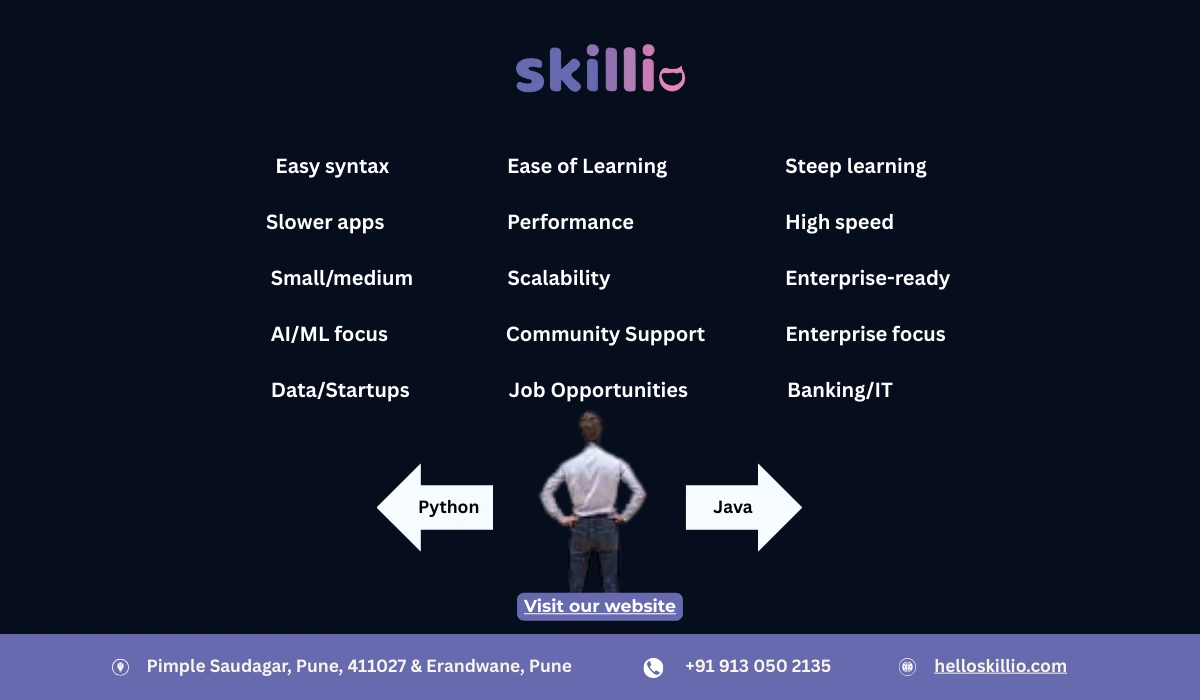
Here’s a quick comparison to help you understand why both languages are used differently:
| Feature | Python | Java |
| Ease of Learning | Beginner-friendly, simple syntax | More complex, steeper learning curve |
| Performance | Slower, less suitable for high-load apps | Faster, reliable for large-scale apps |
| Scalability | Good for small-medium apps | Excellent for enterprise-level systems |
| Community Support | Strong in AI/ML, startups | Strong in enterprise software |
| Job Opportunities | AI, Data Science, Startups | Banking, Finance, IT Services, Enterprises |
Conclusion: Python = Simplicity & Speed, Java = Power & Scalability.
When to Choose Python for Backend
Python is best when:
- You are building small to medium web apps.
- You need to prototype quickly.
- You are working in AI/ML or Data Science domains.
- You want to learn backend basics easily as a student.
Example: A startup building an MVP (Minimum Viable Product) may prefer Python for faster release.
When to Choose Java for Backend
Java is best when:
- You are working on large enterprise systems.
- You need high security, performance, and reliability.
- Your project has millions of users (e.g., banking, insurance, eCommerce).
- You want to pursue a long-term IT career with stable demand.
Example: Banks like HDFC, ICICI, and global financial institutions rely on Java for their backend because of its security and concurrency handling.Industry Use Cases: Where Java & Python Shine
- Java Use Cases:
- Banking & Finance Applications
- eCommerce Platforms (Amazon, Flipkart)
- Enterprise ERPs & CRMs
- Video Streaming Platforms (Netflix)
- Python Use Cases:
- AI/ML Applications (Google AI, TensorFlow projects)
- Startups and SaaS platforms
- Social Media Platforms (Instagram)
- Prototyping & Automation Scripts
Both languages coexist in the tech world — but Java dominates enterprise backend systems, while Python dominates AI and innovation-focused domains.
Career Opportunities: Java vs Python Developers
Java Developer Careers
- Roles: Backend Developer, Full Stack Java Developer, Enterprise Application Engineer
- Industries: Banking, Finance, IT Services, eCommerce
- Average Salary (India): ₹6 – 12 LPA (can go higher in product-based companies)
Python Developer Careers
- Roles: Data Scientist, Python Developer, AI Engineer, Backend Developer
- Industries: AI/ML, Startups, Data-Driven Firms
- Average Salary (India): ₹5 – 10 LPA
Both careers have demand, but Java developers are in higher demand for enterprise IT jobs, while Python developers are preferred in AI & startups.
Which Language Should You Learn First?
This depends on your career goals:
- If you want to enter AI/ML, Data Science, or Startups → Start with Python.
- If you want to enter backend, enterprise IT, and product-based companies → Learn Java first.
- If you aim to become a Full Stack Developer → You need both.
At Skillio by Testing Shastra Pune, we offer a Full Stack Java Developer Course Training that covers Java, Spring Boot, SQL, and frontend frameworks — helping you become industry-ready.
Conclusion
While Python is easier and great for beginners, Java remains the industry standard for backend development because of its scalability, performance, and enterprise adoption.
If you’re a student or professional aiming for a stable IT career with long-term opportunities, Java is the best language to master for backend development.
Want to become the kind of Full Stack Java Developer every company wants?
Explore our Full Stack Developer Course in Pune with Placement Assistance at Skillio by Testing Shastra and start your journey today!


